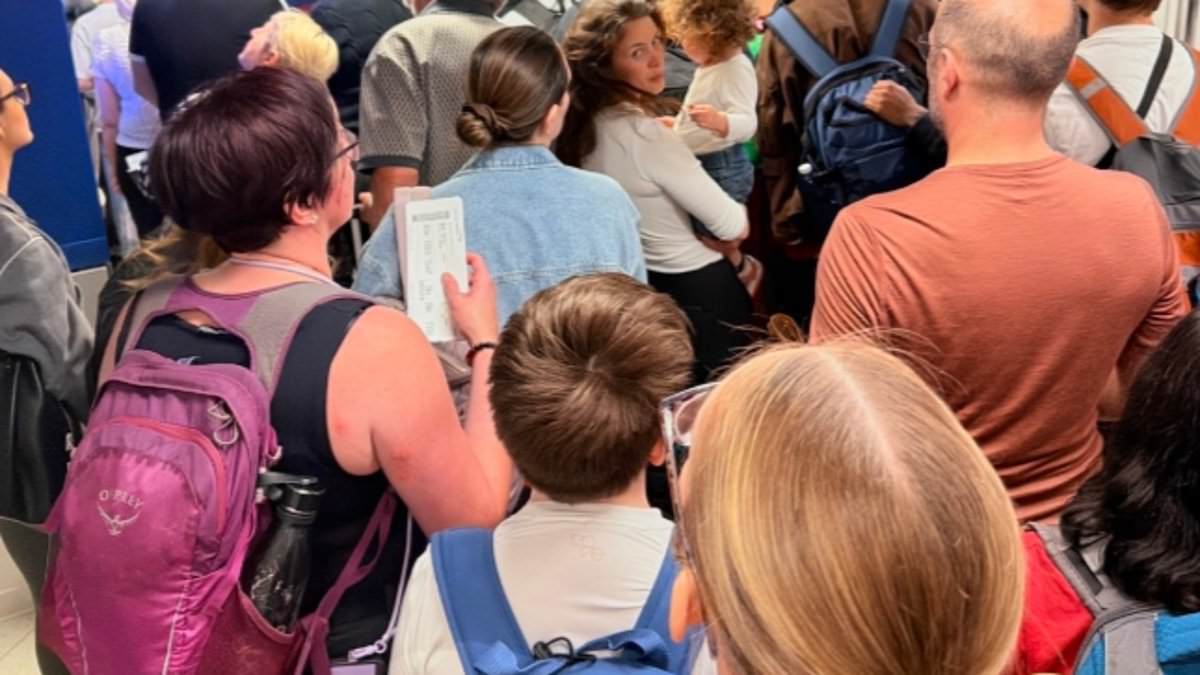
Key Takeaways:
- The EU's new Entry/Exit System (EES) was fully implemented at airports by April 10, requiring non-EU travelers to register fingerprints, photos, and documents.
- Airports in 15 countries report 'very bad' delays, with queues up to 3 hours, according to the Airports Council International (ACI).
- Portugal temporarily suspended EES registration over the weekend to ease congestion; other hubs like Paris, Brussels, and Milan saw passengers missing flights.
- Frustrated travelers share experiences of chaos, equipment failures, and long waits, calling the system 'a nightmare' and 'organised chaos.'
Holidaymakers across Europe are facing hours-long queues and missed flights as the full rollout of the EU's new digital border controls takes effect. The Entry/Exit System (EES), which requires non-EU nationals—including UK citizens—to provide biometric details like fingerprints and photographs at passport control, has sparked chaos at major airport hubs from France to Poland.
Reports from the Airports Council International (ACI) and traveler accounts paint a grim picture: three-hour waits in Lisbon, Paris, and Brussels, with some airports like those in Portugal temporarily suspending EES registration to keep flights moving. The system, designed to strengthen security and monitor third-country nationals' movements, appears to be causing significant disruption at a time when European travel is ramping up for spring.
Chaos at Portuguese Airports
One of the hardest-hit countries is Portugal, where airports in Lisbon, Porto, and Faro reported such severe delays that EES registration was paused over the weekend. Ex-UK and EU diplomat Rupert Joy described 'complete chaos' at Lisbon's Humberto Delgado Airport, with 'loads of people missing flights despite arriving hours in advance because of insanely long queues.'
A Reddit user reported lines 'stretching through the whole very long terminal and then outside,' adding that security had to revert to manual passport stamping to cope. Travelers heading to popular destinations like the Algarve or Lisbon for city breaks are advised to arrive at least 4 hours early.
Poland and Belgium: A 'Nightmare' for Travelers
In Poland, Krakow Airport saw two-hour queues on arrival and 90 minutes for departure. One traveler wrote on X: 'Holy c**p the new EES passport system is a nightmare. Two hours at arrival at Krakow. 90 minutes on departure. Give yourself plenty of time if you're traveling around Europe.' Another said they are reconsidering future trips to Europe.
Brussels Airport hasn't been spared either. Passengers reported delays of up to three hours, with one traveler describing queuing with an eight-month-old baby for over three hours. The ACI confirmed significant disruption to flight operations, with passengers missing flights due to prolonged border processing.
Milan, Paris, and Germany: Overwhelmed Systems
In Milan's Linate and Malpensa airports, passengers endured waits of up to three hours in intense heat, leading to reports of fainting and vomiting. An easyJet spokesperson urged border authorities to use flexibilities to reduce delays. At Charles de Gaulle Airport in Paris, analytics provider Schengen90 reported 240-minute waits on April 11. IT failures and cyber security issues forced many airports to record only personal data, not biometrics.
Germany's Frankfurt, Munich, and Berlin airports also saw three-hour queues, with Berlin's website warning that delays may become the norm due to additional EES steps.
What Travelers Should Do
As the system stabilizes, the ACI's director, Olivier Jankovec, called for ability to suspend EES registration when queues become unmanageable. For now, travelers are advised to:
- Arrive at least 3-4 hours early for flights.
- Have all required documents ready (proof of accommodation, funds, insurance, return ticket).
- Check airport websites for real-time queue updates.
- Consider carrying a physical copy of documents if biometric machines fail.
The chaotic rollout underscores the challenges of implementing large-scale border systems, and travelers should prepare for a bumpy ride as summer approaches.